
Great at a Fair Price: How Durable Growth Powers True Value in Your Portfolio
- Author
- Gustaf Rounick, CFP®, ChFC®
- Published
- Reading
- 5 minutes
- Topics
- Investing
Yet even Graham’s own résumé weakens that tidy story: his single biggest win came from pouring more than half of Graham-Newman’s capital into GEICO, an up-and-coming auto insurer whose customer base and premiums were compounding at break-neck speed. In 1948 he paid about $712,000 for a 50 percent stake; by 1972 that position was worth roughly $400 million—a 562-fold leap that dwarfed all the firm’s other gains combined. Graham himself later quipped that “from then on we seemed to be very brilliant people.” [1]
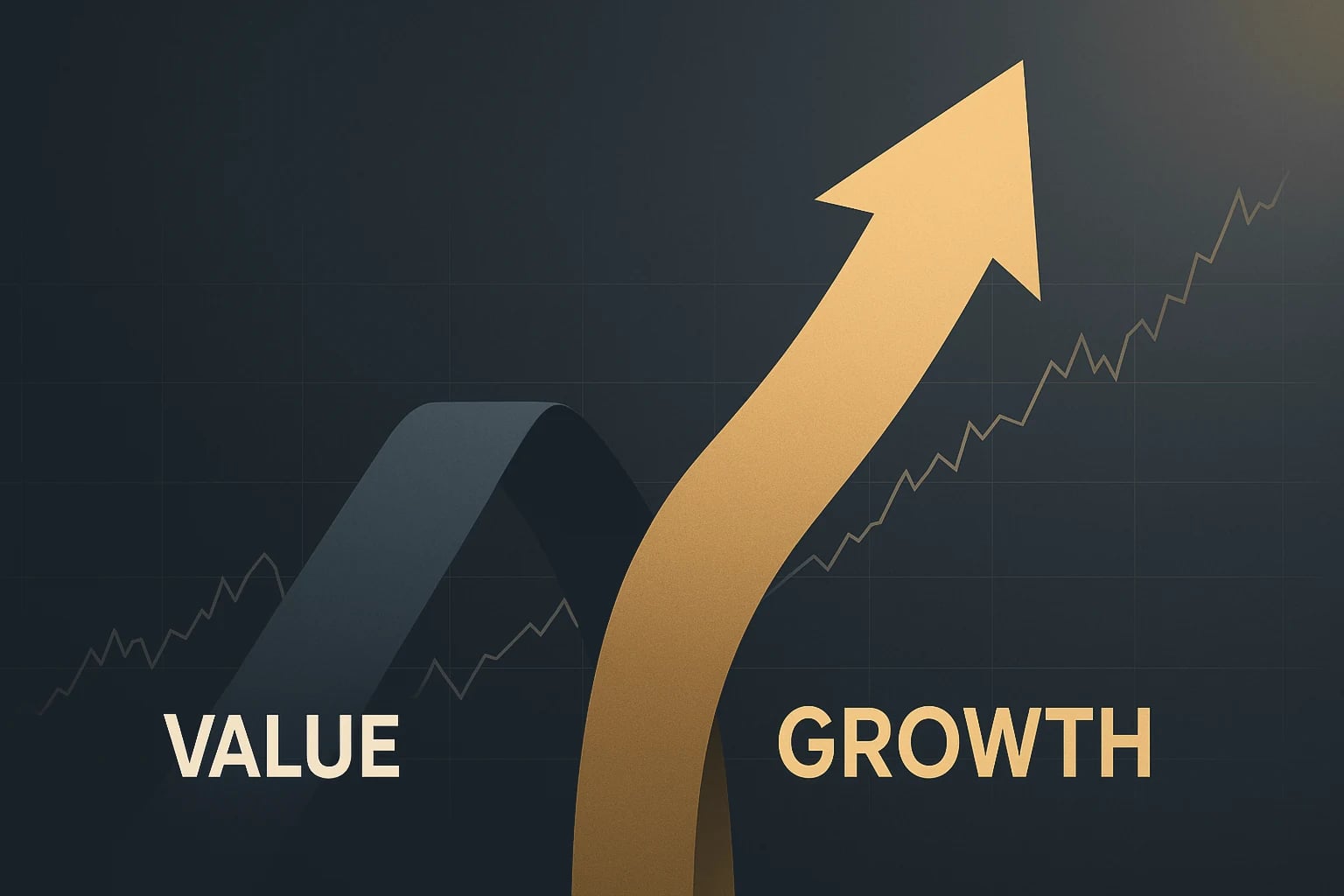
GEICO was not a cigar-butt trading below liquidation value; it was an early-stage growth engine that reinvested profits into cheaper underwriting, lower prices, and wider appeal. Its success demonstrates the central point of this essay: durable growth is not the opposite of value—it is a prime ingredient in the value equation. The intrinsic worth of any company equals the cash it can send to owners over time, discounted back to the present. That stream has two moving parts: the cash you see now and the rate at which it can expand. Long-lasting expansion, purchased at an undemanding price, creates the richest mix.
Why “great at a fair price” beats “fair at a great price”
Imagine two businesses. Company A sells at ten times earnings but grows profits only two percent a year. Company B trades at twenty-five times earnings yet compounds cash flow fifteen percent annually while earning exceptional returns on reinvested capital. Fast-forward a decade. If both firms meet these projections, Company A’s earnings are roughly a fifth higher, while Company B’s have more than quadrupled. Even if Company B’s valuation multiple contracts to twenty, its share price still clobbers Company A’s. The math reveals something counter-intuitive: paying what looks like a premium can actually be the more conservative path when the growth is durable.
Graham’s student Warren Buffett summarized the lesson in plainer language: “It’s far better to buy a wonderful company at a fair price than a fair company at a wonderful price.” [2] What makes a business “wonderful”? Predictable markets, high returns on capital, strong competitive advantages, and leadership that allocates cash wisely. Each of those qualities feeds future growth. Acceptable purchase prices for such firms seldom look like fire-sale bargains in backward-looking ratios, yet they can still offer wide margins of safety because the base of earnings keeps pulling away from the price you paid.
The GEICO paradox and the flaws of static ratios
Skeptics often cling to low price-to-book or low price-to-earnings screens as proof of value discipline. That worked when factories and railcars dominated corporate balance sheets. Today much of a company’s worth sits in code, data, patents, and brand equity—assets that accounting rules largely ignore, making high-growth innovators appear “expensive” while masking the decay inside many seemingly cheap industrial names. Graham himself stretched beyond static yardsticks when he broke his own diversification rules to bet heavily on GEICO. Far from tarnishing his legacy, that detour underlines our theme: growth can be the cheapest asset you ever buy if it compounds for many years.
Separating durable growth from hype
Of course, not every growth story becomes the next GEICO. The market occasionally loses its head, as it did during the dot-com bubble or more recent manias in unprofitable digital-ad startups. Smart investors therefore grade growth on quality, not just speed. Durable growth usually springs from one or more of these roots: cost advantages, network effects, patent protection, high switching costs, or a culture of relentless reinvestment. GEICO’s direct-to-consumer model lowered distribution expenses, allowing it to underprice rivals and still earn superior margins. That edge endured for decades. Contrast that with gadget makers dependent on a fashion cycle; their growth evaporates as soon as buzz fades.
Cheap stocks can be expensive mistakes
Buying a “statistically cheap” balance-sheet stock whose revenue is slipping faster than costs can be riskier than paying up for a compounder. When demand shrinks or technology shifts, the low multiple turns out to be a mirage because next year’s “E” in the P/E ratio falls off a cliff. The deeper danger hides in opportunity cost: while capital sits trapped in a melting-ice-cube enterprise, great businesses are compounding elsewhere. Graham-Newman earned handsome gains on dozens of net-net trades, but none matched the life-changing effect of GEICO. That contrast explains why even investors who do not revere Graham’s entire playbook still owe themselves a close look at his outlier victory.
Practical takeaways for modern portfolios
Start every analysis by estimating a plausible range of long-term growth based on reinvestment economics, not by comparing last quarter’s earnings multiple to an industry average. Stress-test what happens if growth slows by half or a recession clips margins. Buy only when the resulting internal-rate-of-return looks attractive under conservative assumptions. Diversify across several quality growers so that no single thesis can derail your plan, but let winners run. Above all, remember that a margin of safety can reside in resilient cash-flow expansion just as surely as it can in a fat discount to today’s assets.
Why I’m no Graham idol-worshipper
Benjamin Graham deserves credit for formalizing security analysis and teaching generations to anchor their decisions to intrinsic value. Yet his own record shows that clinging too closely to rigid formulas can leave enormous money on the table. Without GEICO, his career statistics would look merely solid rather than legendary. That footnote matters because it reminds us that real-world investing demands flexibility: appreciate the price you pay, but never ignore the force of compounding growth when you can buy it at a sensible valuation.
Closing thoughts
Value and growth are best understood not as competing labels but as complementary dimensions of the same exercise: weighing future cash flows against the check you must write today. Durable growth, bought at a rational price, may be the most underappreciated bargain in the market. Graham’s GEICO bet proves the point—whether or not you count yourself among his fans.
If you would like to explore how a growth-aware value strategy could serve your own long-term goals, book a complimentary 15-minute call.
Important Disclosures
This material is for informational and educational purposes only and should not be construed as personalized investment advice or a recommendation to buy or sell any security. All investing involves risk, including the potential loss of principal. Past performance is no guarantee of future results. Future growth rates and returns are uncertain and may differ materially from projections. Consult your financial, tax, and legal advisers before making any investment decisions. Westlight Wealth is a registered investment adviser in the State of California. Registration does not imply a certain level of skill or training.
Works Cited
[1] https://www.ifa.com/articles/impact_geico_benjamin_graham_warren_buffett_luck_gecko