
RSU Tax Withholding: Why 22% Leaves Los Angeles Executives Owing in April
- Author
- Gustaf Rounick, CFP®, ChFC®
- Published
- Reading
- 6 minutes
- Topics
- Tax planning
Figures reflect rules in effect as of October 2026.
When RSUs vest, employers can withhold income tax at flat supplemental rates: 22% federal and 10.23% California. If your employer does and your federal bracket is 32%, 35% or 37%, the shortfall comes due in April. The California gap is smaller. Both can be estimated at each vest and closed before the bill arrives.
A vest shows up on your pay stub as income, and the shares land in your brokerage account after some are sold to pay the tax. It is natural to read that as the tax being handled. For many Westside professionals and executives it is only partly handled.
The shortfall is predictable, which means it can be planned for. Here is how RSU tax withholding works, how to estimate your own gap, and the ways to close it before the January payment and the April return.
How RSU tax withholding works
When restricted stock units vest, the market value of the shares is wages, taxed like salary. Because it is paid apart from your regular salary, payroll treats it as supplemental wages, which an employer can withhold at a flat federal rate: 22% for 2026. Once your supplemental wages for the year pass $1 million, the rate is 37%.¹
Medicare tax is withheld too, with an extra 0.9% once your wages from one employer pass $200,000 for the year. Your employer withholds it at that point regardless of filing status, although for a married couple filing jointly the tax itself starts at $250,000 of combined wages.²
California withholds separately. The state’s flat rate for bonuses and stock options is 10.23%.³ Look at a vest on your pay stub to see the rate your employer applies to RSUs. California State Disability Insurance takes 1.3% of wages in 2026, with no wage cap, so it applies to every vested share.⁴
Why 22% falls short
The 22% rate is a payroll convenience. It has no connection to your bracket. For 2026, the federal 32% bracket begins at $403,550 of taxable income for a married couple filing jointly, 35% at $512,450 and 37% at $768,700. For a single filer, 35% begins at $256,200 and 37% at $640,600.⁵
A household in the 35% bracket owes 13 cents more on each dollar of vest than payroll withheld. Vests arrive every quarter, and the shortfall builds with each one.
California is closer to the mark. Its top bracket rate is 12.3%,⁶ and a 1% Behavioral Health Services Tax applies to taxable income over $1 million, for 13.3% at the top.⁷ Against a 10.23% flat rate, the state gap runs from nothing to about 3 percentage points, depending on your bracket. The federal gap is the larger one.
A worked example: how big is the gap?
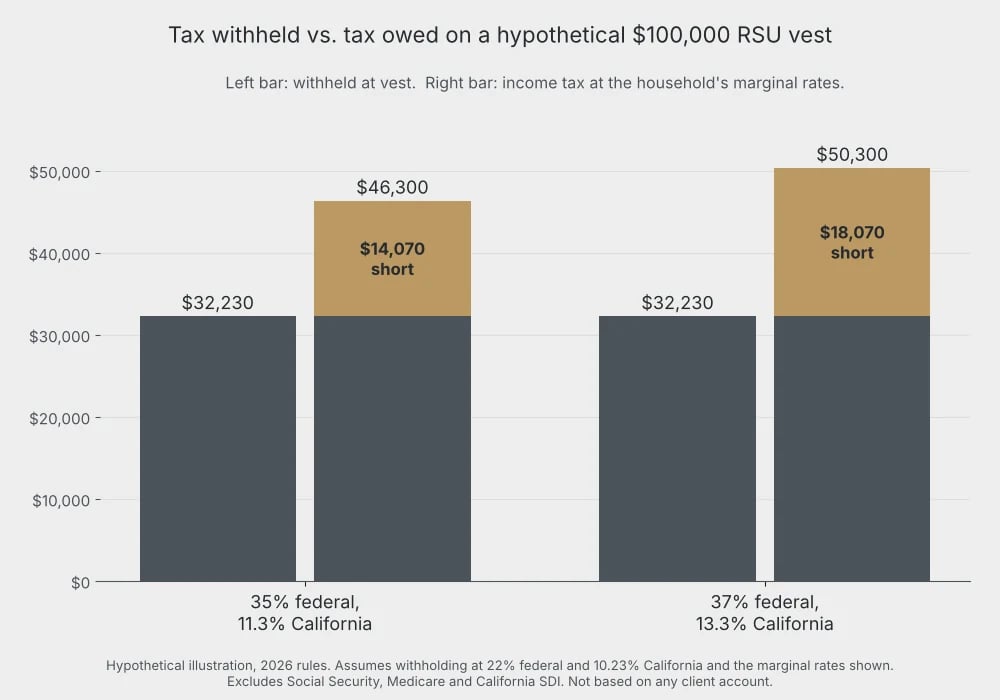
Take a hypothetical $100,000 vest, withheld at 22% federal and 10.23% California: $32,230 in all. Taxed at marginal rates of 35% federal and 11.3% California, the income tax on it is $46,300, a shortfall of $14,070. At the top rates of 37% and 13.3%, the tax is $50,300 and the shortfall is $18,070.
For a rough figure of your own, take your marginal federal rate minus 22%, add your marginal California rate minus 10.23%, and multiply by your vest income for the year.
This is an estimate, not a projection. Your actual tax depends on the whole return: other income, deductions, the alternative minimum tax and credits. Use it to decide whether a gap exists and roughly how large it is, then confirm the number with your CPA or a full projection.
What changes above $1 million
Above $1 million of supplemental wages in a year, federal withholding rises to 37%,¹ the top bracket rate. For the largest equity packages, the federal gap largely closes and a California gap of about 3 points remains.
The same households lose the prior-year safe harbor in California. If your California adjusted gross income is $1 million or more ($500,000 if married filing separately), your estimated payments must be based on the current year’s tax, not last year’s.⁷
Why the timing matters as much as the tax
Paying too little during the year can bring an underpayment penalty on top of the tax. The federal rules give a safe harbor: if your adjusted gross income for the prior year was more than $150,000 ($75,000 if married filing separately), paying 110% of last year’s tax through withholding and estimated payments avoids the penalty, even if you owe more in April.⁸
California has the same 110% rule for AGI over $150,000, with the $1 million exception above, and its own schedule: 30% of the required annual payment by April 15, 40% by June 15, nothing in September and 30% by January 15.⁷ A large vest late in the year is easy to miss on that schedule. I cover safe harbor payments alongside the rest of the year-end tax review.
Five ways to close the RSU withholding gap
- Add withholding to your salary. Enter an extra amount per paycheck in Step 4(c) of Form W-4.⁹ For the federal penalty, withholding is treated as paid in equal parts on each due date,⁸ so extra withholding in November and December can cover a shortfall from earlier vests.
- Make estimated payments. Pay the federal and California estimates on their own schedules. The fourth California installment for 2026 is due January 15, 2027.⁷
- Sell more shares at vest. Selling enough shares to cover the full tax, rather than the amount withheld, sets the cash aside before it is spent or invested.
- Set the cash aside each quarter. After each vest, move an amount sized to your gap into a separate account, such as a money market fund or Treasury bills, until the payment date.
- Project the year in the fall. A tax projection after the third-quarter vest shows the actual shortfall while there is still time to fix it with withholding.
None of these changes the tax itself. They change when you pay it and whether a penalty comes with it. Which mix fits depends on your cash flow, your other income and how much of your employer’s stock you already hold.
Holding vested shares is a second decision
If you keep the shares after they vest, the gap is paid from cash, not from the shares. And because the full value was taxed at vest, keeping the shares is the same decision as buying your employer’s stock with that cash. Your salary, your unvested awards and your vested shares may all depend on one company.
I have written separately on reducing the risk of one large stock position and on planning equity through an IPO. Both fit into how I plan equity compensation.
The Bottom Line
RSU withholding is a payroll default, not a tax calculation. At 22% federal it falls short for anyone in the 32% bracket or above, and California adds a smaller gap of its own. The shortfall can be estimated at every vest. Set the cash aside, and use withholding or estimated payments to stay inside the safe harbor. Planned in the fall, it can be settled without a penalty.
If you would like to size your own gap before the January payment, book a complimentary 15-minute call.
Sources
1. IRS, Publication 15 (2026), Circular E, Employer’s Tax Guide. https://www.irs.gov/publications/p15
2. IRS, Instructions for Form 8959 (2025), Additional Medicare Tax. https://www.irs.gov/instructions/i8959
3. California EDD, DE 231PS, Personal Income Tax Withholding: Supplemental Wage Payments. https://edd.ca.gov/siteassets/files/pdf_pub_ctr/de231ps.pdf
4. California EDD, 2026 California Payroll Taxes (DE 201). https://edd.ca.gov/siteassets/files/pdf_pub_ctr/de201.pdf
5. IRS, Revenue Procedure 2025-32 (2026 inflation adjustments). https://www.irs.gov/pub/irs-drop/rp-25-32.pdf
6. California Franchise Tax Board, 2025 California Tax Rate Schedules. https://www.ftb.ca.gov/forms/2025/2025-540-tax-rate-schedules.pdf
7. California Franchise Tax Board, 2026 Instructions for Form 540-ES, Estimated Tax for Individuals. https://www.ftb.ca.gov/forms/2026/2026-540-es-instructions.html
8. IRS, Instructions for Form 2210 (2025), Underpayment of Estimated Tax. https://www.irs.gov/instructions/i2210
9. IRS, Publication 505 (2026), Tax Withholding and Estimated Tax. https://www.irs.gov/publications/p505
Disclaimer
This article is for educational and informational purposes only and should not be considered personalized financial, tax, or investment advice. Westlight Wealth is a dba of Rounick Capital Management, LLC, a registered investment adviser with the State of California. Registration does not imply a certain level of skill or training. Past performance is not indicative of future results. All investing involves risk, including the potential loss of principal. Tax laws are complex and subject to change; the information here reflects rules in effect as of the date of publication. Please consult a qualified tax professional or financial adviser before making decisions specific to your situation.
Any figures shown are hypothetical illustrations intended to demonstrate a concept. They are not based on, and do not reflect, the actual results of any Westlight Wealth client account. Individual results will differ.